Line of enquiry:
Through my iterations, I explored how abstraction can be derived out of objects to become symbols. I am curious to question and explore the complexities and challenges that arise when letterforms are not simplified. Does time and efficiency affect the complexity of how we draw/ create forms? How would letterforms have evolved if we could communicate with leisure? Can a script be composed of complex symbols instead of simple abstract forms? Is our understanding of a simple versus a complex alphabet dependent on what scripts we are able to read and understand? I’m curious to explore what an uncontrolled or unrationed letterform or script would look like and the ways in which I could arrive at the same.
References picked from the MAGCD Reading List:
Drawing, Writing and Calligraphy in Lines by Tim Ingold
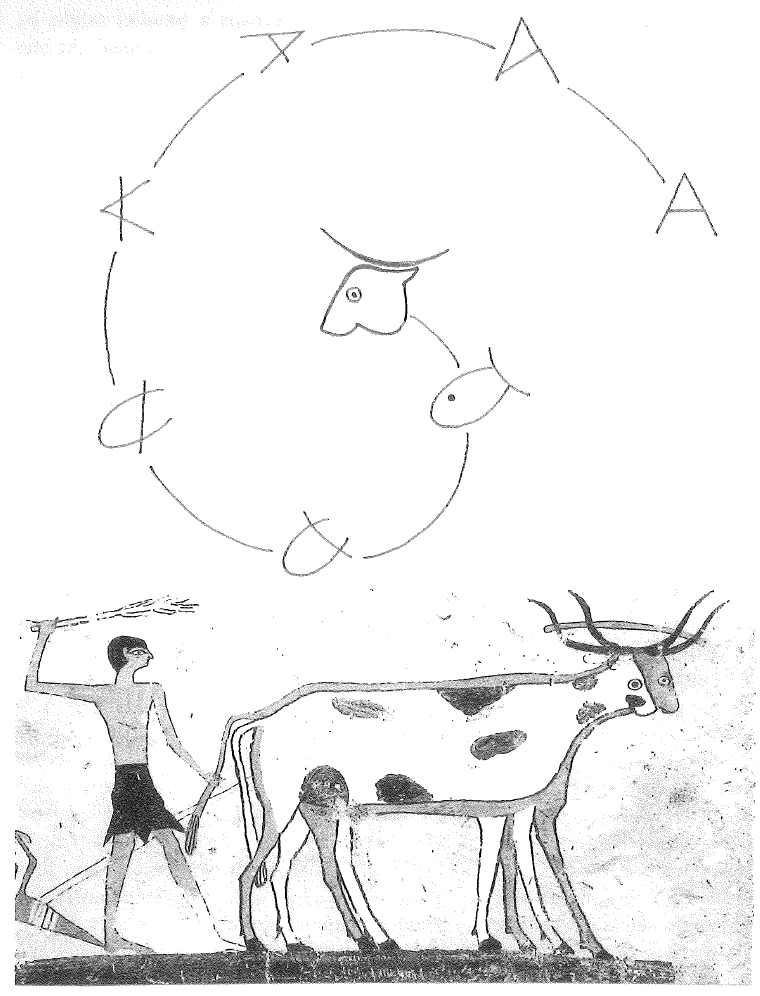
I’m particularly interested in how the author notes that writing is a special form of drawing in which “what is drawn comprises the elements of a notation”. He describes how our understanding of a symbol/ sign/ note is purely based on what we accept it is representative of or signifies or denotes. He gives an example of an imagined form of the alphabet ‘H’ (a drawing by poet BP Nichol) which “may or may not be described as writing depending on whether we are prepared to accept that it bears any resemblance to the letter called by its name in any recognised script or typeface”. He describes how some notations were also derived from depictions. He cites the example of how the alphabet A’s origin can be traced back to a pictographic depiction of an ox’s head. He also writes about how some words can be written and not written at the same time. He suggests that the same notational elements can sometimes be used to denote different things in different contexts.
Ingold, T. (2016). Lines. Routledge.
Coral Dictionary by Chang Yuchen

Through this project, Chang Yuchen gives a new form to Bahasa Malayu, a language indigenous to Malaysia. The project aims to compose a new visual language for Bahasa Malayu, which is written in the Latin script. She notes how years of colonisation and cultural exchange have impacted the evolution of the language and its written form. Through the project, she translated 216 words into her own system that she calls the ‘Coral dictionary’; she derives the forms of these alphabets from the shapes of the corals. What interested me the most about her project is how she arrived at the symbolism for each shape; she associated the shapes of certain corals with forms that felt familiar to her, e.g., a face-shaped coral representing the word permukaan or face. It was inspiring to see how she didn’t shy away from using ‘complicated & unconventional’ shapes to represent the symbols that formed the coral script.
Dictionary, C. (2019). Chang Yuchen. [online] Chang Yuchen . Available at: https://changyuchen.com/coraldictionary.
In Reference to the Theme/ Subject Matter:
The Evolution of Writing published by Denise Schmandt-Besserat
This article compiles the evolution of writing and the multiple levels of abstraction that writing went through. The article describes the evolution of alphabets as ‘multifold’, from physical tokens to simple drawings (pictographs) to signs representing sounds of speech (logographs) and then to its contemporary forms. It also notes how one of “the most striking universal feature of all writing systems, is their uncanny endurance, unmatched among human creations”. The alphabet seems to have undergone minimal evolution since its ‘invention’ unlike other human creations. This made me question whether humans have deferred from abstracting the form of contemporary alphabets further or not. I was also intrigued by the parallel development and abstraction of various scripts.
The Evolution of Writing: Wright, J. (2014). The Evolution of Writing | Denise Schmandt-Besserat. [online] utexas.edu. Available at: https://sites.utexas.edu/dsb/tokens/the-evolution-of-writing/.
In Reference to the Method:
Conditional Design Manifesto
For the process of abstraction that I used in my iterations, I was influenced by the Conditional Design Manifesto’s advice on avoiding arbitrary randomness. In order to depict a plant in various ways, I set various ‘rules’ to help me derive abstract forms. For example, drawing the plant within a grid, using only ellipses, where all lines emerge from the centre of a circle. I was able to rectify the arbitrariness that posed a challenge to me during the first draft of my iterations. The constraints stimulated play within the limitations and I was able to conceptualize new forms with more intent.
Maurer, L., Edo Paulus, Puckey, J. and Roel Wouters (2013). Conditional design workbook. Amsterdam: Valiz.
In Reference to Critical Positions related to my topic:
Course in General Linguistics by Fredinand de Saussure
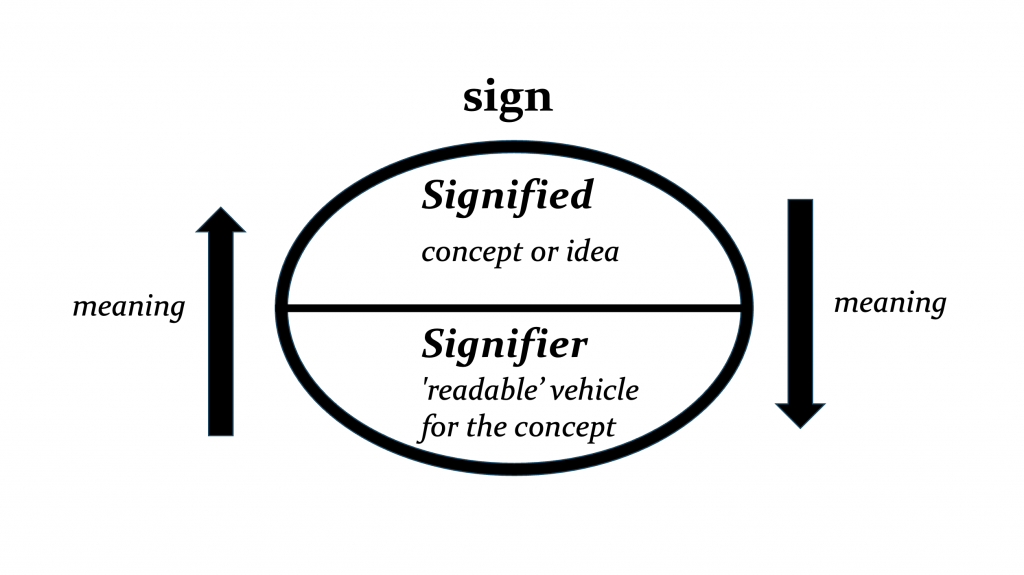
Ferdinand de Saussure suggested that for a sign to exist there must be a signifier and a signified. He described a ‘signifier’ as an object or form representing a sound, image or word and a ‘signified’ as something that represents or stands for an object or an idea, i.e., the concept of a word. The sign exists as a union of the ‘signifier’ and the ‘signified’. The word ‘symbol’ according to him is used to designate a linguistic sign. He also suggested that the connection between a symbol and its ‘original form’ is intrinsic. For example, the letters c-a-t has no visual connection to the form of a cat. Using this understanding, I was able to catalogue my iterations into two categories, that of the signifier and the signified.
Saussure, F.D. (1916). Course in General Linguistics. London: Duckworth.
Peirce’s Theory of Signs by Charles Sanders Peirce
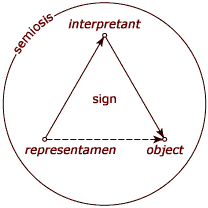
Charles Sanders Peirce defines signs as a triadic process, not just a signifier-signified pair as proposed by Saussure. He classified signs based on their relation to objects. An ‘icon’ is a representation of the original form of an object (for example, a diagram of a heart). An index represents that object through an implied or physical understanding of an object (for example, the heart-shaped emoji used as a symbol for love). It doesn’t look like the original object that it is representative of, but it represents an abstract concept related to it. A symbol represents an object through conventionally agreed-upon rules (for example, the alphabets H-E-A-R-T look nothing like the actual shape of the heart but stands for it). This broadened my understanding of forms and the symbolism behind them by pushing me to question who makes the rules that define certain symbols. It got me asking myself the true meaning of forms; if all forms are arbitrary and abstract in nature, and we as humans assign meanings to them.
Atkin, A. (2006). Peirce’s Theory of Signs. [online] Stanford Encyclopedia of Philosophy. Available at: https://plato.stanford.edu/entries/peirce-semiotics/.