Category: Positions
-
Written Prompt: Projections through Contextualizing
Extended Bibliographies:
The Book of Symbols: Reflections on Archetypal Images
Created with the Archive for Research in Archetypal Symbolism (ARAS)
A compilation of over 350 essays and 800 visual representations of objects and artifacts from around the world, this book explores how ancient visual symbols and metaphors influence the human psyche. It draws heavily on Carl Jung’s work on the unconscious mind. This archive of images provides insight into how humans make sense of the world. I began to think about how humans have historically attached abstract qualities to tangible entities in order to make sense of intangible emotions. For example, in the chapter about chairs, the authors state, “a chair signifies the elevation accorded by power or status.” This affirmed my understanding of how an object like a chair possesses inherent symbolisms that transcend its functional use. This book acted as a key resource that encouraged me to uncover the historical symbolisms embedded within ordinary objects.Ronnberg, A. (2021) The Book of Symbols.
The UNESCO Virtual Museum of Stolen Cultural Objects
This virtual museum was created by UNESCO Member States to raise public awareness about the illicit trafficking of cultural property. The Member States were invited to select stolen objects of importance whose theft symbolizes a significant impoverishment of their national cultural heritage. Exploring the objects in this museum solidified my understanding of humans and their association with objects. Objects hold the power to not only become a part of an individual’s identity, but can also extend to represent the identity of a group, culture or nation. According to me, this project is proof of the hidden ‘emotional’ weight objects carry and of how a stolen object results in a stolen part of history. History is interpreted not only through narratives, but also through shared objects. When these objects are taken away, it can result in an impoverished understanding of one’s identity.UNESCO Virtual Museum of Stolen Cultural Objects (2025) Unesco.org. Available at: https://museum.unesco.org/.
Pioneer Plaques
The Pioneer Plaques are a set of iconographic-symbolic, gold-anodized aluminium objects sent into space by NASA aboard the Pioneer 10 and 11 spacecraft. They were intended as a message to any ‘intelligent’ extraterrestrial life that might possess the technology and apparatus to decode them. I was initially drawn to the plaques because of the intriguing combination of symbols and icons they contain. I was keen to explore the relationship between icons and symbols, and the emergence of abstract forms. However, as my project has evolved, I have become more intrigued by the object itself. The object not only represents the existence of humanity, but also a quest to communicate and connect with other beings. The meaning of the plaque, thus, transcends its function like any other object.NASA (2018) Pioneer Plaque – NASA Science, science.nasa.gov. Available at: https://science.nasa.gov/resource/pioneer-plaque/.
Studies in Iconology: Humanistic Themes in the Art of the Renaissance
The art historian Erwin Panofsky describes a symbol as ‘a medium through which the human mind attaches spiritual, cognitive, or philosophical meaning to a concrete, material sign’. In this book, he elaborates on his three-step method for understanding and interpreting symbols: primary or natural subject matter, secondary or conventional subject matter, and intrinsic meaning or content. Primary meanings are derived from the forms or visual cues that help identify an object (eg: identifying a pink flower growing in a pond as a lotus). Secondary meanings are the symbolisms, themes or stories related to the object (eg: identifying a lotus is a symbol of spiritual awakening and purity). Intrinsic meanings are the meanings arising from socio-political contexts (eg: knowing that the lotus on a flag represents an inept and authoritarian political regime in India). This text builds upon my understanding of Ferdinand de Saussure’s concept of the signifier and the signified by splitting my understanding of the signified into two parts. The added distinction of socio-political events influencing our perception of objects expanded my understanding of how the symbolisms embedded in objects can transform over the years depending on when, where and how they are used.Panofsky, E. (2019) STUDIES IN ICONOLOGY : humanistic themes in the art of the renaissance. Routledge.
Are We human: notes on an archeology of design
Written by architectural theorists Beatriz Colomina and Mark Wigley, this book argues that artifacts do not simply serve a function, but constantly reinvent and redesign what it means to be human. In the chapter “The Mirror of Design” they expound on how the average day involves experiencing thousands of overlapping layers of design that form intricate webs. The text suggests that the archaeology of design is not just about the history of the human being as an animal as revealed through layers of artifacts, but also represents the many ways in which humans have reinvented themselves over time. In the chapter “The Plastic Human” they state that “the human is inseparable from the artifacts that it produces, with the human body having the extended shape of all the artifacts it has made and each artifact being an intimate part of its biology and brain. The artifacts are more human than the human.” This adds a new dimension to my understanding of objects. I believe that reimagining objects as extensions of humans, rather than simply the result of human intervention, accentuates the importance of objects in shaping human history and vice versa.Colomina, B. and Wigley, M. (2016) Are we human? : notes on an archaeology of design. Lars Mul̈ler, pp. 9–27.
45 Symbols: Clay to Code
This book documents a 320-page publication of a decade-long, global design research project exploring visual language, symbolic systems and collective ways of seeing. It compiles over 2000 unique symbols and draws inspiration from the Phaistos Disc, a 3700-year-old, still-undeciphered clay disc that features 45 unique, stamped visual signs. This book uses this historical transition of our evolution from drawing symbols on clay to using digital code as a metaphor to explore how modern designers build visual systems to communicate personal and global narratives. From using patterns derived from plastic containers to tracking patterns of migration in symbols, this book provided me with an elaborate understanding of what a symbol is and what it could mean. It inspired me to question what a visual system constitutes and how one could conceptualize a system from a variety of objects.
Olivier Arcioli, Pascal Glissmann and Henrich, A. (2026) 45 Symbols – Clay to Code.
Extended Analysis:
45 Symbols: Clay to Code
This book documents a decade-long design project that began as a design seminar series titled “The Phaistos Project– Forty-five Symbols”. The volume compiles over 2000 unique symbols selected through a series of open calls, exhibitions, and workshops conducted by the creators. Each project not only expands our understanding of visual language but also becomes an archive of experimentation and intercultural dialogue. Through its extensive collection of symbols and visual systems, the book positions meaning as fluid and culturally constructed rather than fixed or universal.
The inspiration for the project came from the Phaistos Disc, a 3700-year-old, still-undeciphered clay disc featuring 45 unique stamped visual signs. While the artifact itself remains unreadable, the project shifts focus away from decipherment and instead treats the disc as a starting point for inquiry into symbols, communication and material history. In this way, the project applies experimental archaeology as a method of inquiry, shaping how we study and question form, material meaning, and use. The book’s structure reinforces this concept through its archival presentation of collected works. By compiling hundreds of interpretations from different cultural and disciplinary perspectives, this publication emphasizes on the importance of variation, experimentation and open-ended interpretation of form rather than a singular or definitive meaning.
In the book ‘Are We Human?’, Beatriz Colomina and Mark Wigley point out that “Artifacts are therefore never simply the representatives of human intentions and abilities. They are also openings, possibilities of something new in the human, even a new human. There is always a gap between intentions and what is produced. The artifact offers something unexpected, some additional quality or resistance. This excess opens up new ways of thinking, new modes of design.” The book mirrors this notion by acting as an insightful window into the various ways in which meaning can be derived from artifacts and material traces. Instead of presenting symbols as purely communicative forms, the projects forward the concept of symbols as evolving cultural objects shaped by the interactions they have with us, the contexts in which we study them and the various interpretations we can derive out of them.
Two projects in the book that stood out to me and helped shape my ongoing inquiry were PET Proof of Identity and Chews a Character. While the former provides a forensic analysis of common polluting objects, the latter creates a bizarre anthropological archive of Western individuality. Both projects use material in different ways to construct narratives and convey meaning. While one project highlights impressions left by objects as marks of their presence and environmental impact, the other uses impressions on objects as indicators of personality and identity. Their methods of documentation, classification and presentation transform ordinary materials into symbolic evidence. They demonstrate how design can function as both research and storytelling.
The book’s archival structure reinforces the idea that meaning is transient, unstable and subjective. By presenting varied interpretations of similar themes, the projects encourage viewers to see symbols as culturally constructed rather than universally fixed. This reminds me of one of Panofsky’s quotes “linear perspective is not a natural or objective way of seeing, but a culturally constructed mathematical abstraction…”. Applying that understanding to the book allowed me to see more clearly how culture and identity shape the way we perceive symbols and visual systems. The projects also challenged my understanding of graphic design as purely functional communication by presenting design as a form of archaeological, anthropological and material inquiry.
This book has influenced the way I want to develop my own project by encouraging me to experiment more deeply with objects, material traces and symbolic interpretation. It pushes me to think beyond symbols or symbolic objects as static graphic forms and instead approach them as cultural artifacts shaped by context, use and perception. I am particularly keen on trying to incorporate various methods of collection, documentation and material experimentation into my process to explore how meaning can emerge through our interaction with objects and their traces.
Are We human: notes on an archeology of design
Beatriz Colomina and Mark Wigley’s Are We Human? positions design not as a secondary layer added to human life, but as something fundamentally intertwined with the construction of humanity itself. In the chapters titled “The Mirror of Design” and “The Plastic Human,” they argue that humans and artifacts continuously shape one another, suggesting that objects are extensions of one’s body, mind and identity and not just passive tools that we invent and reinvent continuously. Their claim that “the artifacts are more human than the human” emphasises on the role of design (of an object) as a fundamental force that constantly reconstructs what it means to be a human being. It positions design as a cultural and biological system through which humans construct meanings and identities. They also create a network of interconnected ideas rather than a linear argument. This structure reflects their central thesis implied in the chapter ’The Mirror of Design’ that design operates as an intricate web embedded within everyday life. This web-like structure also reinforces their idea that humans are inseparable from the objects they create.This concept strongly connects with another reference of mine: The Book of Symbols, which similarly explores how objects accumulate meanings beyond their functional purpose. Both references suggest that objects are never neutral and evolve over time. They are also loaded with historical and emotional significance. However, while The Book of Symbols approaches and catalogues artifacts through the lens of symbolic meanings humans attach to them, influenced by Carl Jung, Colomina and Wigley focus more on the symbiotic relationship between humans and artifacts. Together, these texts helped deepen my understanding of ordinary materials we possess by showing that their existence communicates not only their functionality but it is deeply intertwined with how humanity has evolved over time.
Studying this book alongside the UNESCO Virtual Museum of Stolen Cultural Objects further expands my understanding of the symbiotic relationship between humans and artifacts by demonstrating how objects can embody collective identity and historical memory. The museum positions stolen artifacts as lost possessions that result in voids within cultural narratives. This reinforces the book’s central argument that objects are extensions of humans. When an object is removed or stolen, a part of a culture’s identity is also disrupted. The emotional weight attached to these stolen artifacts reveals how deeply intertwined material objects are with memory, belonging and human history. Together, these references challenge the idea that designed artefacts are carriers of cultural and emotional meaning.
These ideas will significantly shape the development of my project. I could perhaps investigate how ordinary objects function as emotional and symbolic extensions of human identity. I plan to explore the hidden narratives and associations attached to objects in various ways. I could also use this as a means to further understanding historical inherited symbolisms that are embedded in everyday objects that we take for granted. Additionally, I can use this understanding to examine how meanings get attached to everyday objects to communicate loss, memory or fragmented identity. This could pave a way for me to uncover and reconstruct the layered and complex relationships between humans and the objects that shape their existence.
-
Written Prompt: Projections through Iterating
Line of enquiry:
Through my iterations, I explored how abstraction can be derived out of objects to become symbols. I am curious to question and explore the complexities and challenges that arise when letterforms are not simplified. Does time and efficiency affect the complexity of how we draw/ create forms? How would letterforms have evolved if we could communicate with leisure? Can a script be composed of complex symbols instead of simple abstract forms? Is our understanding of a simple versus a complex alphabet dependent on what scripts we are able to read and understand? I’m curious to explore what an uncontrolled or unrationed letterform or script would look like and the ways in which I could arrive at the same.
References picked from the MAGCD Reading List:
Drawing, Writing and Calligraphy in Lines by Tim Ingold
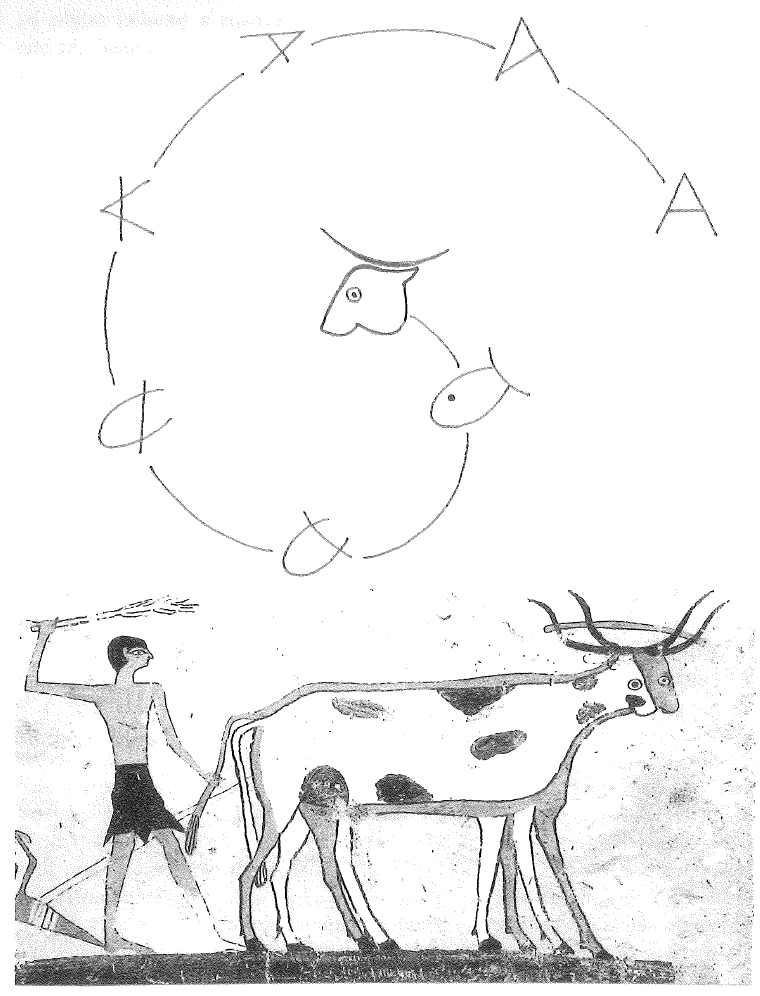
Evolution of the alpbhabet ‘A’. I’m particularly interested in how the author notes that writing is a special form of drawing in which “what is drawn comprises the elements of a notation”. He describes how our understanding of a symbol/ sign/ note is purely based on what we accept it is representative of or signifies or denotes. He gives an example of an imagined form of the alphabet ‘H’ (a drawing by poet BP Nichol) which “may or may not be described as writing depending on whether we are prepared to accept that it bears any resemblance to the letter called by its name in any recognised script or typeface”. He describes how some notations were also derived from depictions. He cites the example of how the alphabet A’s origin can be traced back to a pictographic depiction of an ox’s head. He also writes about how some words can be written and not written at the same time. He suggests that the same notational elements can sometimes be used to denote different things in different contexts.
Ingold, T. (2016). Lines. Routledge.
Coral Dictionary by Chang Yuchen

Alphabets made from Coral forms for the Bahasa Malayu language.
Through this project, Chang Yuchen gives a new form to Bahasa Malayu, a language indigenous to Malaysia. The project aims to compose a new visual language for Bahasa Malayu, which is written in the Latin script. She notes how years of colonisation and cultural exchange have impacted the evolution of the language and its written form. Through the project, she translated 216 words into her own system that she calls the ‘Coral dictionary’; she derives the forms of these alphabets from the shapes of the corals. What interested me the most about her project is how she arrived at the symbolism for each shape; she associated the shapes of certain corals with forms that felt familiar to her, e.g., a face-shaped coral representing the word permukaan or face. It was inspiring to see how she didn’t shy away from using ‘complicated & unconventional’ shapes to represent the symbols that formed the coral script.Dictionary, C. (2019). Chang Yuchen. [online] Chang Yuchen . Available at: https://changyuchen.com/coraldictionary.
In Reference to the Theme/ Subject Matter:
The Evolution of Writing published by Denise Schmandt-Besserat
This article compiles the evolution of writing and the multiple levels of abstraction that writing went through. The article describes the evolution of alphabets as ‘multifold’, from physical tokens to simple drawings (pictographs) to signs representing sounds of speech (logographs) and then to its contemporary forms. It also notes how one of “the most striking universal feature of all writing systems, is their uncanny endurance, unmatched among human creations”. The alphabet seems to have undergone minimal evolution since its ‘invention’ unlike other human creations. This made me question whether humans have deferred from abstracting the form of contemporary alphabets further or not. I was also intrigued by the parallel development and abstraction of various scripts.
The Evolution of Writing: Wright, J. (2014). The Evolution of Writing | Denise Schmandt-Besserat. [online] utexas.edu. Available at: https://sites.utexas.edu/dsb/tokens/the-evolution-of-writing/.
In Reference to the Method:
Conditional Design Manifesto
For the process of abstraction that I used in my iterations, I was influenced by the Conditional Design Manifesto’s advice on avoiding arbitrary randomness. In order to depict a plant in various ways, I set various ‘rules’ to help me derive abstract forms. For example, drawing the plant within a grid, using only ellipses, where all lines emerge from the centre of a circle. I was able to rectify the arbitrariness that posed a challenge to me during the first draft of my iterations. The constraints stimulated play within the limitations and I was able to conceptualize new forms with more intent.
Maurer, L., Edo Paulus, Puckey, J. and Roel Wouters (2013). Conditional design workbook. Amsterdam: Valiz.
In Reference to Critical Positions related to my topic:
Course in General Linguistics by Fredinand de Saussure
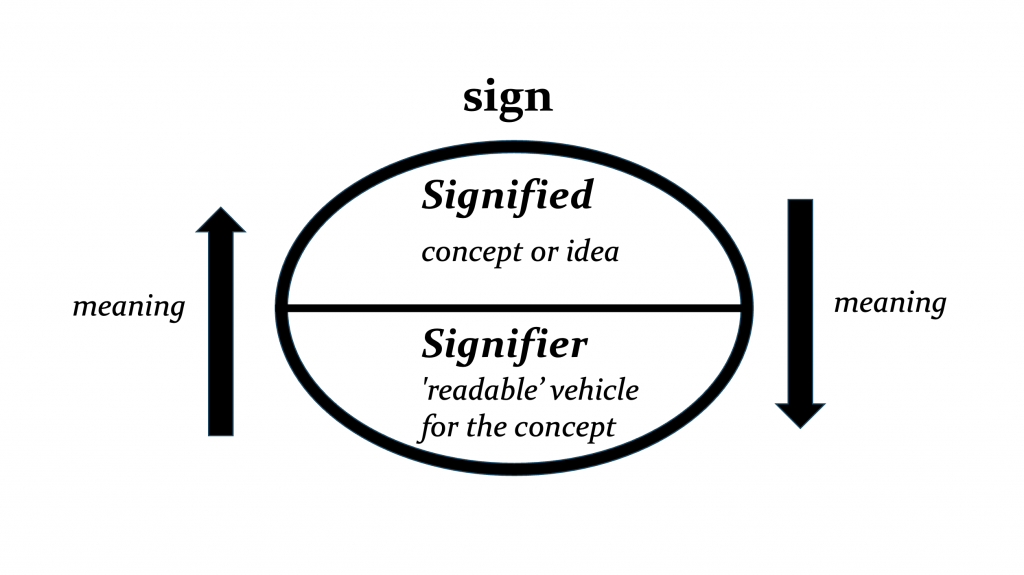
Difference between the ‘signifier’ and ‘signified’ Ferdinand de Saussure suggested that for a sign to exist there must be a signifier and a signified. He described a ‘signifier’ as an object or form representing a sound, image or word and a ‘signified’ as something that represents or stands for an object or an idea, i.e., the concept of a word. The sign exists as a union of the ‘signifier’ and the ‘signified’. The word ‘symbol’ according to him is used to designate a linguistic sign. He also suggested that the connection between a symbol and its ‘original form’ is intrinsic. For example, the letters c-a-t has no visual connection to the form of a cat. Using this understanding, I was able to catalogue my iterations into two categories, that of the signifier and the signified.
Saussure, F.D. (1916). Course in General Linguistics. London: Duckworth.
Peirce’s Theory of Signs by Charles Sanders Peirce
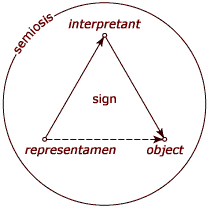
Triadic Diagram of the three types of signs. Charles Sanders Peirce defines signs as a triadic process, not just a signifier-signified pair as proposed by Saussure. He classified signs based on their relation to objects. An ‘icon’ is a representation of the original form of an object (for example, a diagram of a heart). An index represents that object through an implied or physical understanding of an object (for example, the heart-shaped emoji used as a symbol for love). It doesn’t look like the original object that it is representative of, but it represents an abstract concept related to it. A symbol represents an object through conventionally agreed-upon rules (for example, the alphabets H-E-A-R-T look nothing like the actual shape of the heart but stands for it). This broadened my understanding of forms and the symbolism behind them by pushing me to question who makes the rules that define certain symbols. It got me asking myself the true meaning of forms; if all forms are arbitrary and abstract in nature, and we as humans assign meanings to them.
Atkin, A. (2006). Peirce’s Theory of Signs. [online] Stanford Encyclopedia of Philosophy. Available at: https://plato.stanford.edu/entries/peirce-semiotics/.