Draft 1
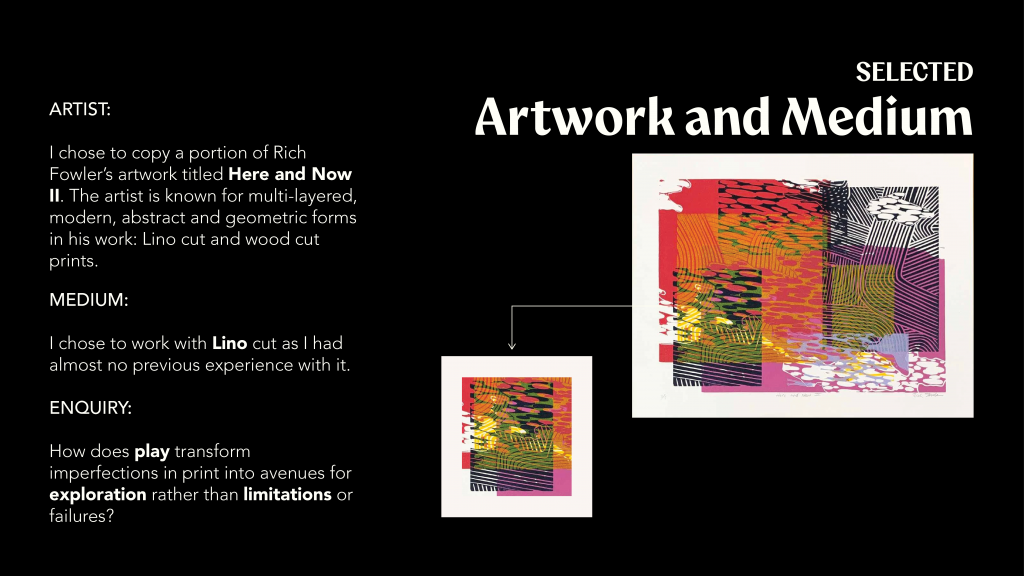
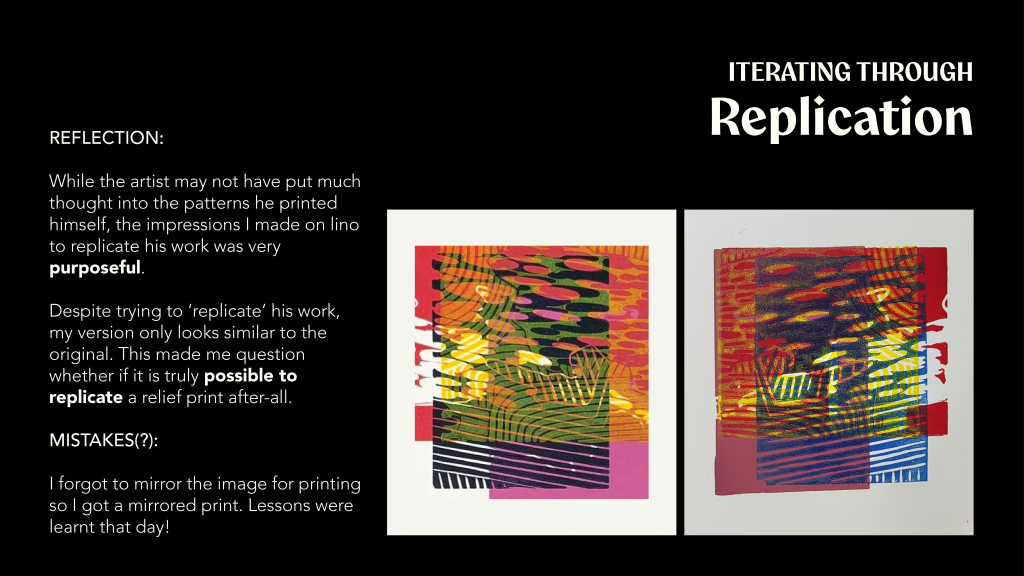
For this unit, I would like to copy a portion of Rich Fowler’s artwork titled Here and Now II 1. The artist frequently explores multi-layered, modern, abstract, and geometric forms in his work. Through this inquiry, I aim to explore the demand for perfection in print design shapes the outcome and what it means to be perfect or imperfect in printmaking. I also would like to explore how play transforms imperfections in print into avenues for exploration rather than limitations or failures.
Lino printing is an unforgiving medium to work with. On one hand, it demands precision at every stage as each cut is irreversible, while on the other, it leaves space for experimentation and the acceptance of uncertainty. Unlike digital design tools, where mistakes can be instantly undone, lino printing requires a willingness to take risks.
Draft 2
For this unit, I chose to copy a portion of Rich Fowler’s artwork titled Here and Now II 1. The artist frequently explores multi-layered, modern, abstract, and geometric forms in his work. Through this inquiry, I aim to explore how play functions as an important aspect of graphic design, and how it enhances understanding of a tool or medium one chooses to work with. I also explore how play transforms imperfections into avenues for exploration rather than limitations or failures.
Lino printing is an unforgiving medium to work with. On one hand, it demands precision at every stage as each cut is irreversible, while on the other, it leaves space for experimentation and the acceptance of uncertainty. Unlike digital design tools, where mistakes can be instantly undone, lino printing requires a willingness to take risks.
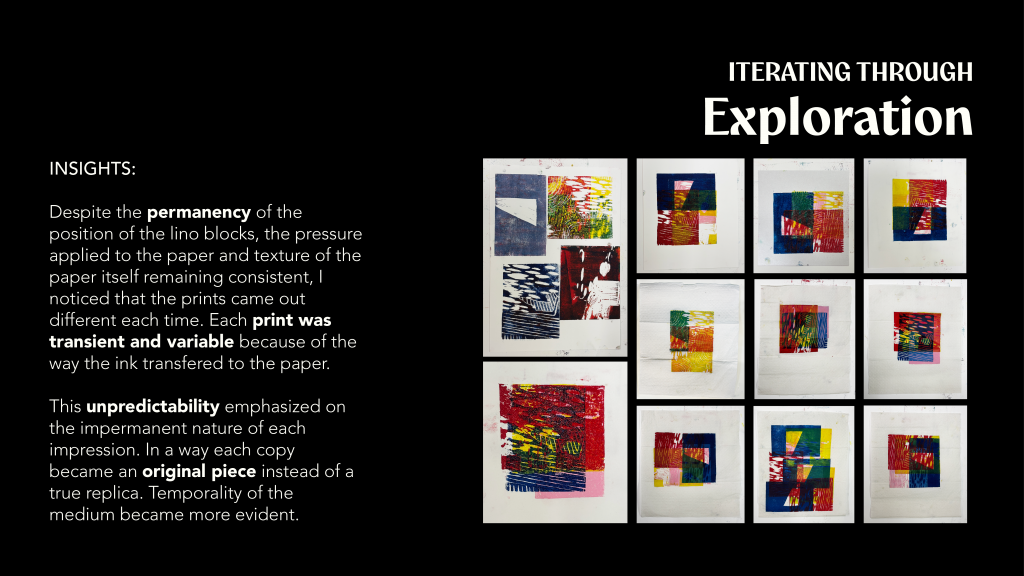
Charles Jencks and Nathan Silver’s concept of Adhocism (1972)2 advocates for improvisation, responsiveness and the creative use of available conditions. I often found myself unable to predict what the outcome of each print would look like even when ink was applied in the same way, pressure was evenly distributed, and layers were aligned consistently. Adhocism helped me reframe this imperfection and constraint as an opportunity rather than it becoming a shortcoming. In lino printing, unpredictability generates unique outcomes. The slight misalignments or inconsistencies in ink application becomes evidence of a process.
Draft 3
For this unit, I chose to copy a portion of Rich Fowler’s artwork titled Here and Now II 1. The artist frequently explores multi-layered, modern, abstract, and geometric forms in his work. Through this inquiry, I aim to explore how play functions as an important aspect of graphic design, and how it enhances understanding of a tool or medium one chooses to work with. I also explore how play transforms imperfections into avenues for exploration rather than limitations or failures.
Charles Jencks and Nathan Silver’s concept of Adhocism (1972)2 advocates for improvisation, responsiveness and the creative use of available conditions. I often found myself unable to predict what the outcome of each print would look like even when ink was applied in the same way, pressure was evenly distributed, and layers were aligned consistently. Adhocism helped me reframe this imperfection and constraint as an opportunity rather than it becoming a shortcoming. In lino printing, unpredictability generates unique outcomes. The slight misalignments or inconsistencies in ink application becomes evidence of a process.
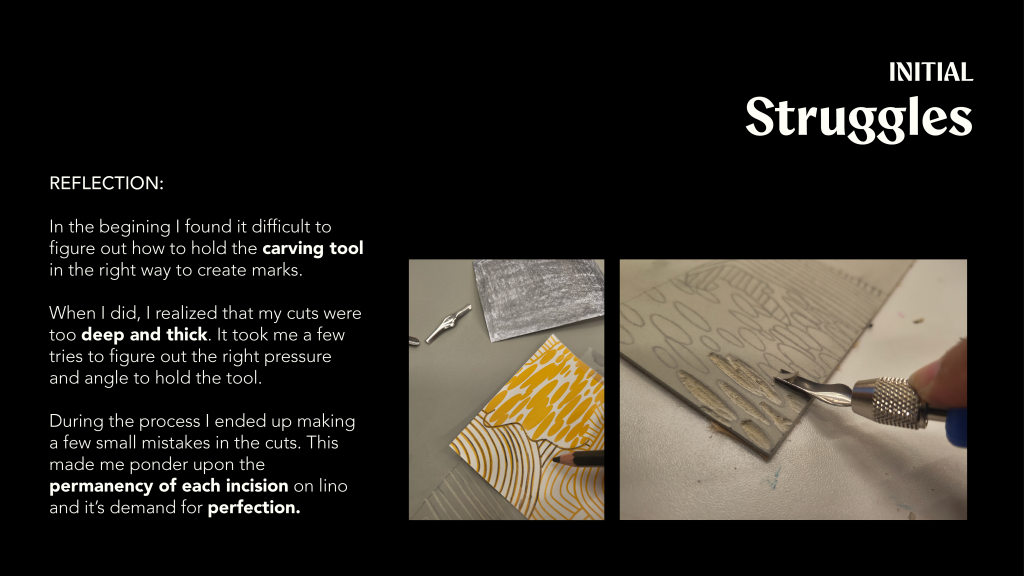
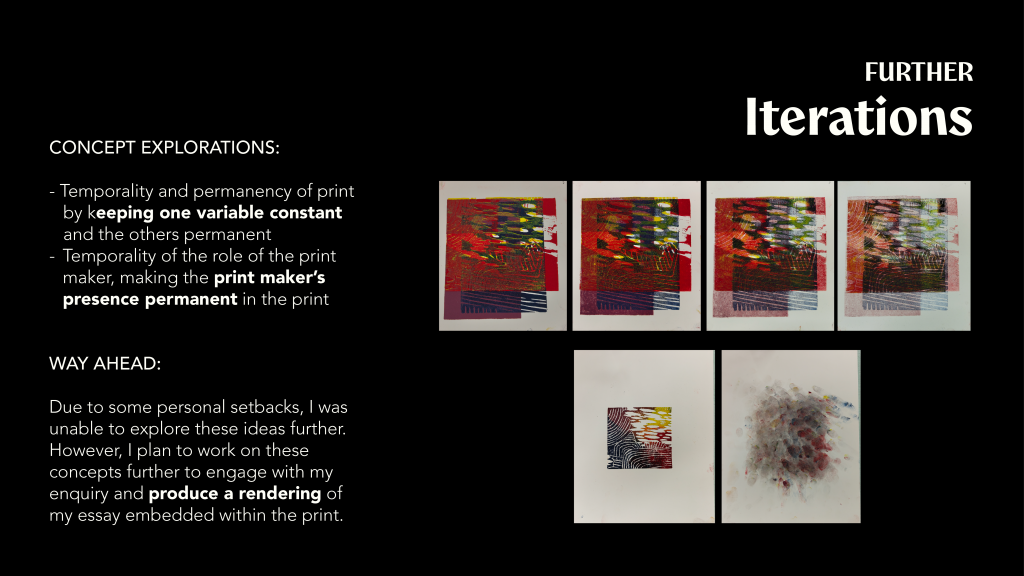
Lino printing is an unforgiving medium to work with. On one hand, it demands precision at every stage as each cut is irreversible, while on the other, it leaves space for experimentation and the acceptance of uncertainty. In a way, it became a conversation between temporality and permanency. Permanency is most evident in the carving process itself. Each incision that I made into the lino block was irreversible and acted as a permanent record of my actions. Unlike digital tools, where I would have had the choice to edit forms and mistakes could be easily undone, lino carving demanded commitment at every cut. This sense of permanency made me feel more aware of the process and my intention with the linoleum and highlighted the materiality of the medium.
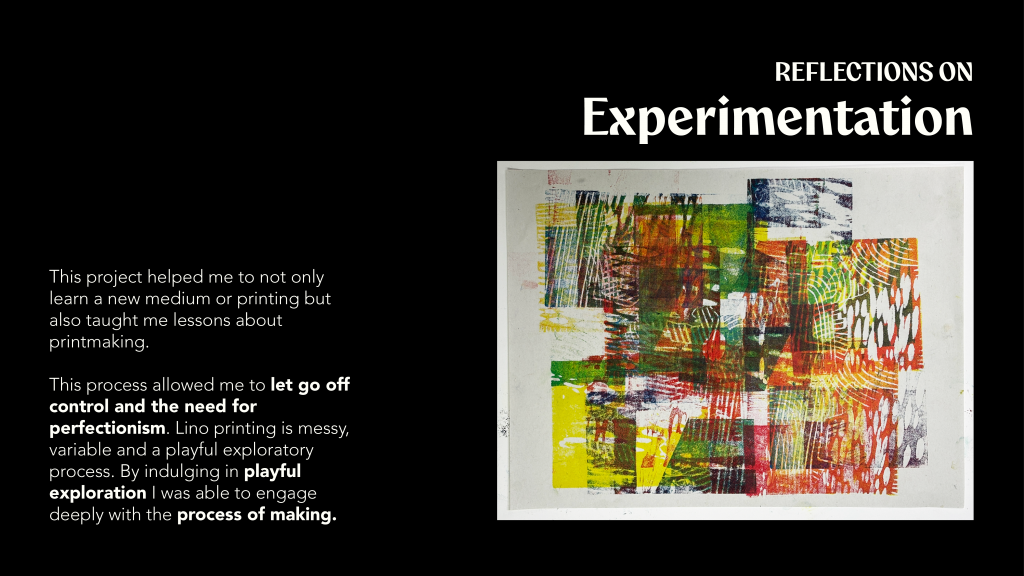
In contrast, temporality emerged within the act of printing. Despite the permanence of the carved block, each print was transient and variable. Subtle changes in ink application, method of applying pressure, paper texture and alignment resulted in outcomes that could never be fully replicated. Even when attempting consistency, no two prints were truly identical. This unpredictability emphasises on the impermanent nature of each impression and positions each outcome as a moment rather than a fixed result that I was initially intending to achieve. In a way each copy became an original piece instead of a true replica.
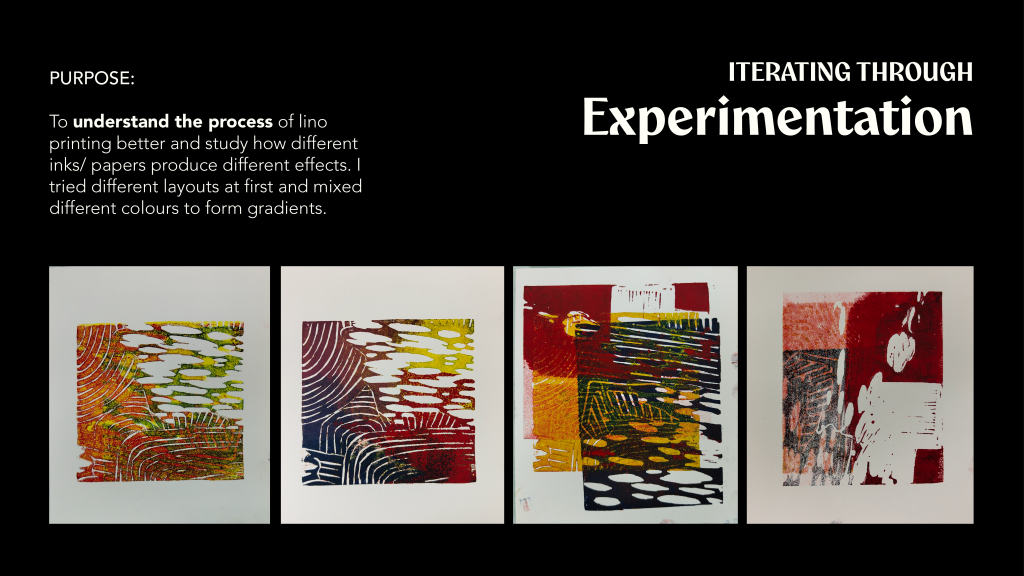
The idea of play bridges these two states. By engaging playfully with lino, the imperfections and inconsistencies transformed from failures into temporary events that contributed to my discovery and learning process. Experimenting with different papers and layouts allowed my process to remain open-ended and unpredictable, despite the permanent nature of the carved block. In a way, lino printing embodies a balance between permanence in decision-making and temporality in outcome. It encourages a mindset that values exploration, risk-taking and presence in the act of making.
References: